Understand
How to get students’ attention in the age of AI
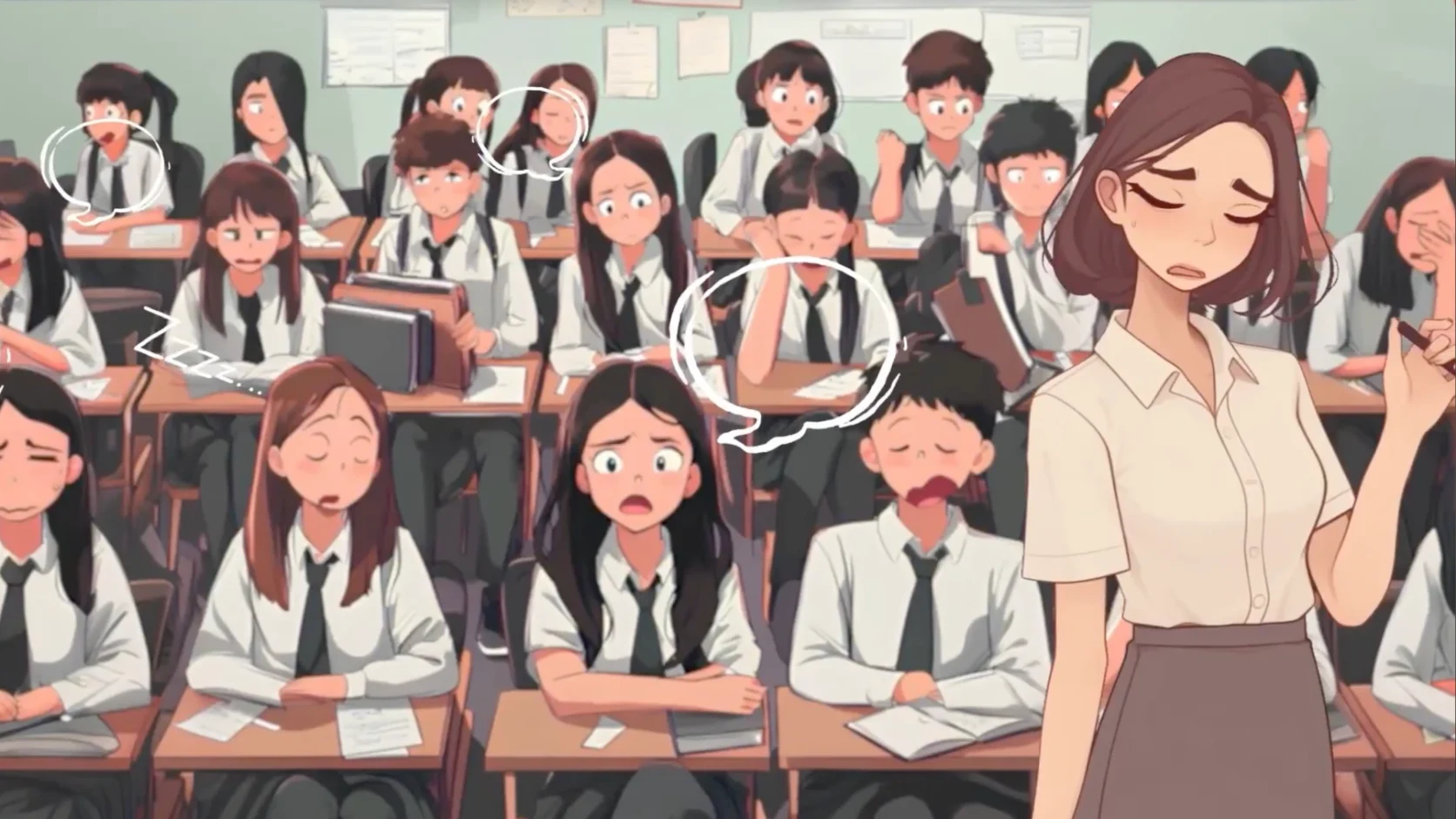
Knowledge has never been easier to come by: the causes of the French Revolution, or how to factor a polynomial, are now one prompt away. An AI will explain them in seconds and never get tired of it. Your students know that. In a YouGov survey from June 2026, nearly eight in ten young people aged 11 to 17 in France said they use an AI tool like ChatGPT [1].
For a long time, school was where you went to get knowledge. Now knowledge is everywhere. What’s in short supply is students’ attention. Back in 1971, Herbert Simon, who went on to win the Nobel Prize in economics, put it this way: “a wealth of information creates a poverty of attention” [2]. So the question teachers face has changed: how do you get students’ attention, and keep it?
Why is it so hard to get students’ attention?
Start with the classroom. In the OECD’s PISA 2025 survey, 37% of 15-year-olds in France say their classmates don’t listen to the teacher in most or all of their science classes, compared with an OECD average of 29% [3]. The OECD rolls these answers into a classroom climate index: of its 38 member countries, France ranks fourth from the bottom [3].
And it’s not just school. According to France’s national book agency, the Centre national du livre, young people aged 7 to 19 spend just 18 minutes a day reading books for fun, versus three hours of their free time a day on screens [4]. Their phones never leave them alone, either: the U.S. nonprofit Common Sense Media tracked the phones of 203 young people aged 11 to 17 for a week, and half of them got at least 237 notifications a day [5]. Between notifications, their feeds serve up videos they swipe away the second they get bored. You can’t swipe away a class.
People like to say this generation can’t focus anymore. Yet these same students will spend hours on a video game. They fail, try again, help each other out, and nobody is making them. So their attention hasn’t gone anywhere. The real question is what holds it.
So what holds their attention?
Neuroscientist Stanislas Dehaene names four pillars of learning: attention, active engagement, feedback and consolidation [6]. A video game delivers all four.
Watching a movie or sitting through a lecture, you just take things in. In a game, you’re doing something every second. Dehaene puts it in one line: “a passive organism does not learn” [6]. You know right away whether you got it right. Getting it wrong costs nothing, because you just try again, and trying again is how things stick. Your mind never gets a chance to wander. In a 2013 study by Harvard researchers, slipping short tests into a recorded lecture cut students’ mind-wandering in half [7].
A game also tells a story. And people aren’t AIs, not yet anyway. They like a good story: a 2021 meta-analysis covering more than 33,000 participants found that people understand and remember a story better than an explanatory text [8].
So what can a class borrow from games? We dig into that in our article on game-based learning.
What’s the teacher’s role when knowledge is everywhere?
The one nobody else can play. An AI can explain, but it won’t notice the student zoning out in the back row. UNESCO says AI cannot replace teachers; if anything, they’re being entrusted with “more responsibility than ever” [9]. When knowledge is everywhere, what’s left is making students want it. That’s the whole challenge of student motivation and engagement. What no prompt will get you is a whole class’s attention for 55 minutes.
And that’s exactly where teachers get the least help from their tools. Many of the big ideas in teaching are over a century old: Maria Montessori opened her first Children’s House in 1907, and Célestin Freinet brought a printing press into his classroom in 1924. Since then, innovation in schools has mostly meant technology, and now AI.
AI helps above all with prep: in the OECD’s TALIS 2024 survey, teachers who use AI mostly use it to read up on a topic and plan their lessons [10]. But attention is won later, in front of the class. The same survey found that middle school teachers in France spend about 18% of class time just keeping order, the most basic part of classroom management: nearly ten minutes out of every 55 [10].
How do you get the whole class’s attention without a complicated tool?
With an attention getter as old as dice: chance. Sociologist Roger Caillois made it one of his four great families of games, alea, where luck decides [11]. Call on a student at random to answer the next question (the old popsicle-stick trick, or equity sticks): participation no longer depends on the same three hands going up, and suddenly the question is everyone’s business. Every student is thinking, “It could be me.”
We built Actoon around that move. You put the game up on the projector from your computer; Summoning (a random draw) picks a student, who answers out loud. In class, students don’t need a device: no phones, no tablets. There’s nothing to set up in the game, and your lesson stays exactly the way you planned it.
Ms. B., who teaches history and geography at a middle school near Marseille, shared her experience at our talk at the Educatech trade show in 2024. She worried that by calling on just one student, she’d lose the rest of the class. It’s the other way around: “while we’re picking the student, everyone is listening” [12]. She added that the tool is anything but clunky.
Actoon speaks the language of the games your students already play, and you get their attention from the very first random draw: where it can take several minutes to stop the chatter and get the class quiet, we see classes ready in two. Want to go further? Turn an entire chapter into a Raid, a whole-class quiz game (see the Product page for the details). But you don’t have to: the random draw is all you need to get started.
See for yourself: the free version lets you try Actoon with one of your classes. And if you’ll be at the Educatech trade show, come hear our talk on Wednesday, December 2, at 4 p.m. in Room 2, or stop by our booth in the startup village any day.
Sources
- YouGov for Interface (2026), “Parents et adolescents face à l’IA générative,” June 2026 report published in October 2026, p. 15 (online survey of 970 young people aged 11 to 17 in France, June 24 to 30, 2026, self-reported: 78% use a general-purpose generative AI). files.interface-eu.org
- Simon, H. A. (1971), “Designing Organizations for an Information-Rich World,” in M. Greenberger (ed.), Computers, Communications, and the Public Interest, The Johns Hopkins Press, pp. 40-41.
- OECD (2026), PISA 2025 Results (Volume I), country note for France, p. 10, and Table I.B1.4.132 of Volume I (15-year-olds, science lessons, self-reported: “most lessons” or “every lesson”); France’s rank on the index of disciplinary climate among the 38 OECD member countries (the survey covers 91 countries and economies): same table, and DEPP (2026), Note d’information no. 26.39, figure 24. oecd.org
- Centre national du livre and Ipsos (2026), Les jeunes Français et la lecture, March 2026, pp. 15 and 16 (representative sample of 1,500 young people aged 7 to 19, January 28 to February 9, 2026, self-reported). ipsos.com
- Radesky, J. et al. (2023), Constant Companion: A Week in the Life of a Young Person’s Smartphone Use, Common Sense Media, p. 10 (203 young Americans aged 11 to 17, Android phones, automatic tracking for one week, August to November 2022; 237 is the median). commonsensemedia.org
- Dehaene, S. (2014), “Fondements cognitifs des apprentissages scolaires,” Collège de France lecture series, session 3: “L’engagement actif, la curiosité, et la correction des erreurs,” slide 5 (our translation). college-de-france.fr
- Szpunar, K. K., Khan, N. Y. and Schacter, D. L. (2013), “Interpolated memory tests reduce mind wandering and improve learning of online lectures,” PNAS, 110(16), 6313-6317 (experiment 2: 48 Harvard students, 21-minute recorded lecture). doi.org
- Mar, R. A., Li, J., Nguyen, A. T. P. and Ta, C. P. (2021), “Memory and comprehension of narrative versus expository texts: A meta-analysis,” Psychonomic Bulletin & Review, 28(3), 732-749 (37 articles, 78 samples, 33,078 participants; texts read or listened to). doi.org
- UNESCO (2023), Global Education Monitoring Report 2023, “Technology in education: A tool on whose terms?”, summary, box 1, p. 13 of the English edition. unesdoc.unesco.org
- OECD (2025), Results from TALIS 2024: The State of Teaching, Tables 1.60 (uses of AI) and 3.36 (class time), middle school teachers, self-reported. doi.org
- Caillois, R. (1958), Les Jeux et les Hommes. Le masque et le vertige, Gallimard (the four families of games: agôn, alea, mimicry, ilinx).
- Actoon (2024), “Le futur de l’éducation n’est pas (que) dans le numérique mais dans le ludique,” talk at the Educatech trade show, November 13, 2024, testimony from a history and geography teacher (from minute 29, in French; our translation). youtu.be